
An Open System
Wiseman (VI): High School II (1994)

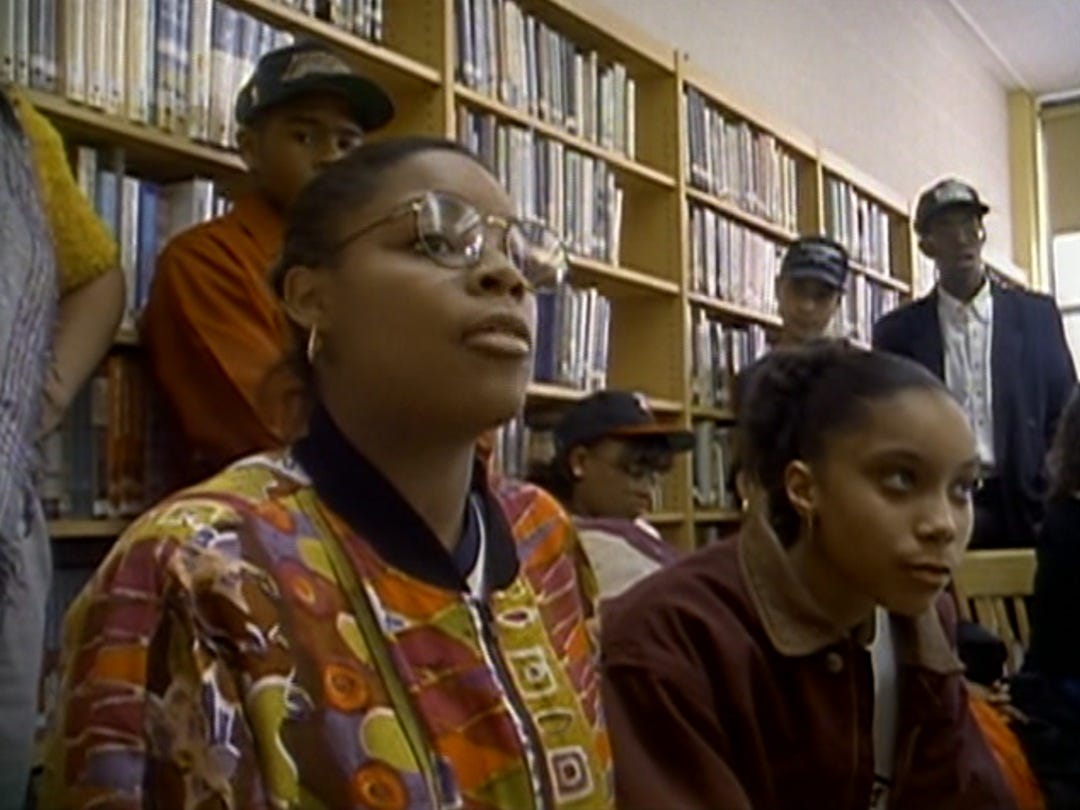
“So that’s the idea that we’re struggling with. How to create a school that’s powerful enough to turn kids on to the possible power of ideas in their lives.” Those are the last lines spoken in High School II, in a meeting in which one of the school’s teachers is talking to visiting ones. It is the mix of affirmation and doubt that most stabs at more forward education often involve. The desire to empower students in the face of the usual passive ones, but also the uncertainty of what they will do with the tools given. Of course, it comes in the context of the kind of visit and discussion that is as much about selling the school and its methods as discussing students; forward-thinking educational places like the one Wiseman visited often exist under this need, justifying and selling themselves for outsiders. After over three hours of mapping the place and the power relationships developed there, the movie comes to a stop in this note that is hopeful but uncertain.
Frederick Wiseman made High School in 1968, his second movie, he released High School II in 1994, going back to education and the eternal struggle between teachers and administrators and the students under them. They couldn’t be more different movies, and in some ways the latter one exists as much for what it shows as in the distance between them. A distance that is as much about the filmmaker as education. High School II‘s title is a tell; it expects us to think about the earlier movie while operating far from an expansion of it. Wiseman did not set up to make a return to American schools to see what changed in between that quarter of a century; he made the second one at Central Park East Secondary School, located at Spanish Harlem in New York, one of those schools that are trying to think of new and better ways to help students to learn by themselves. Wiseman clearly admires the place, which sets it far from most of his movies made until this point. The first High School did visit its chosen school with a lot of suspicion; it also picked it for its averageness, one place that stands for the American educational experience, while High School II is a movie about Central Park East Secondary School, which makes it a very different experience.
Education, of course, changed a lot in between Wiseman’s movies. I went to school in the 90s, at a couple of places that are nowhere like the one this movie depicts, and it still was very far from the one in the 1968 one. I remember talking about my school with my parents and other old family members, and even as a teenager I could tell they went to far more rigid, dull places than I did. High School is one of Wiseman’s better-known movies, but I think it is one of his lesser ones. It has a few remarkable scenes, but it strikes me as one of his least curious works, arriving at its school with a lot of certainties that the place did nothing to challenge. It was a movie as fixed as the education system it was filming, and as much as it laments how defeated the students often were under an oppressive power structure, they come off as tools for the movie Wiseman wants to make. High School was a movie about an idea of an education system, while the 1994 is about this school, the teenagers that go there, and the adults who try to run it the best they can. Considering this, it is no surprise that, by contrast, what most registers in High School II is the students’ faces. There is, for instance, an incredible scene of a mediation after two boys got into a fight that is allowed to go on for some twenty minutes that I’m sure I will always remember everyone involved.
This approach is central to the movie’s power. Even by his usual standards, Frederick Wiseman is very willing to let scenes play. This is a movie about exchanges of power between students among themselves, between them and their teachers, and at times among the adults, and it understands those scenes need their space. Time has always been one of Wiseman’s major weapons; he knows his movies don’t need to fit a 90-120 minute commercial frame, and he also has a discipline of including fewer situations and making the ones he decides to highlight count. There are a lot of strong exchanges whose points of view and shifting positions are registered patiently. Wiseman is clearly fascinated by this school; there is an awe about its possibilities, even if it is understood that it is an experiment in process. The movie becomes a wonder of extending time; moments that could feel simple become not only essential but also very easy to get lost in. One does want to stay in those classes and meetings.
The school is fairly diverse, as its Spanish Harlem setting suggests. Wiseman’s work from the 90s onwards will become increasingly more adept at observing the cultural clashes inside its American society. It makes a lot out of how this is a school for working class teens from multiple backgrounds run by teachers that are more often than not White. The school is seen as a success because it has been very competitive with better funded schools with more privileged student bodies when it comes to send students to colleges. Regardless of how forward thinking a school might be, these are still the stats that rule it. Racial tension inside and outside the school is allowed to hang over the action. Wiseman shot it in 1992, around the time of the trial of the cops who murdered Rodney King. The school operates under the idea that its students are co-conspirators who are allowed to think for themselves and speak their minds, but this is sometimes easier in theory than in practice. One can often sense the adults exasperated at their charges and the pushback that they can offer.
The school is a very delicate battlefield that hopes everyone will ultimately come off on top. The better moments of High School II are the ones when it and its institution seem to be in sync on these desires. The filmmaker’s appreciation of it is rewarded by the place and, above all, the young people who go there. The first High School had a very Foucauldian logic to it, school as a space with a clear point of view that must be absorbed on very narrow terms; the second one has school as an attempt at democracy. Learning is a more free flowing idea. It makes sense that this appeals deeply to Wiseman, who seems genuinely moved by the school efforts. He shapes his movie as a mirror of this idea; it seems ready to go in multiple directions and is more than willing to “waste” time in its dead ends. It is a very rewarding experience, and an honest one in the moments it allows doubts and limitations to slip in.